
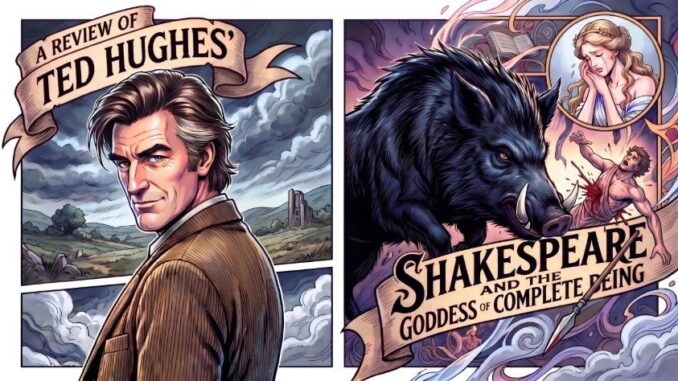
Ted Hughes (1930–1998) was an English poet with a deep sense of the shamanic power of myth. He believed he had uncovered a structural mythic pattern in fourteen or fifteen of Shakespeare’s mature plays. This pattern consisted of two parts, which first appear in two of Shakespeare’s narrative poems: Venus and Adonis (part one) and The Rape of Lucrece (part two).
Hughes called this two-part mythic structure Shakespeare’s “tragic equation”, which he sought to elucidate in Shakespeare and the Goddess of Complete Being (Faber & Faber, 1992).
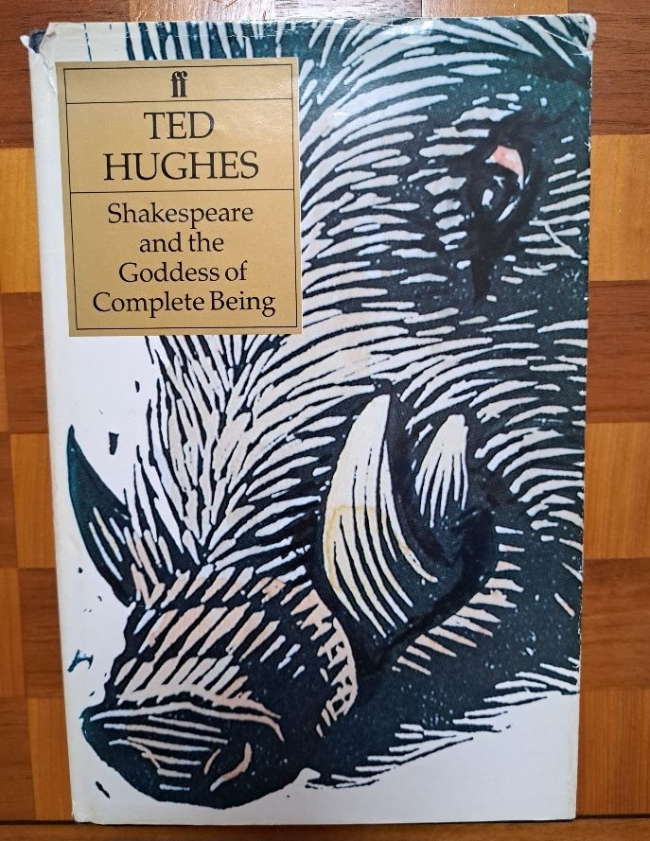
I bought my copy of the book in a second-hand bookshop in York, England, in 1998, just a couple of months after Ted Hughes had died. It’s the first edition, hardback with dust jacket.
Although I’ve dipped into it several times over the years, especially when researching my paper on Shakespeare’s poem The Rape of Lucrece, this year was the first time I’d actually attempted to read it from cover to cover.
I was reading it in preparation for a presentation to an academic circle of English literature professors that meets once a year here in Hiroshima to discuss topics around “Shakespeare and Contemporary Literature”. It was to this group that I presented my paper on Lucrece the previous year. This time, I decided to take the “easy” route of simply reviewing Shakespeare and the Goddess of Complete Being rather than undertaking any fresh research.
I have since completed that review, which you can read here:
On Ted Hughes, Shakespeare and the Goddess of Complete Being
What is Shakespeare’s “Tragic Equation”?
The key to Shakespeare’s “tragic equation” is found, according to Ted Hughes, by splicing the plots of Shakespeare’s two early narrative poems together to reveal a mythic pattern that taps into the trauma of the English Reformation. The mythic pattern of the first poem generates the mythic pattern of the second.
The two poems are:
- Venus and Adonis (1593)
- The Rape of Lucrece (1594)
Venus and Adonis (1593)
Venus has fallen in love with Adonis but, in Shakespeare’s unique twist, Adonis resists her advances, preferring to go hunting wild boar.
Just as Venus fears, Adonis is gored by a wild boar and dies. A purple and white flower grows where his blood was spilled. Venus plucks it to her bosom and returns to Paphos; Adonis is “reborn” as the flower in Venus’s bosom.
The Rape of Lucrece (1594)
The Roman prince Tarquin lusts after Lucrece, the chaste wife of Collatine, and rapes her.
She summons her kinsfolk, calls upon them to take revenge, and commits suicide. They incite the outraged Romans to expel the Tarquins, and the Roman Republic is born.
Extracting the Mythic Pattern from the Poems
Venus, the Goddess of Love, pursues her beloved, who rejects her and is killed by the Boar.
Venus and the Boar are, according to Hughes, two manifestations of the same female divinity, who can appear either as the Goddess of Love or as the Queen of Hell in the shamanistic form of a Boar.
In short, the Boar is the jealous goddess in another guise, exacting revenge upon the one who rejected her.
What Does This Have to Do with the English Reformation?
The “rejected goddess” is now the Virgin Mary, who has been rejected by Adonis the Puritan. We might think of the Boar as the Whore of Babylon in animal guise, and all the danger she poses to Puritan sensibility from Spenser to Bunyan and beyond.
We might say that Venus and Adonis embodies the Protestant experience of rejecting the “idolatrous” veneration of the Virgin Mary, and the dangers that such a rejection entailed.
But just as the goddess has various faces (divine lover, bride, holy mother, Queen of Hell), so too does the Boar. One manifestation is the bestial form of the female goddess of the underworld. Another is found in Hughes’s interpretation of the mythic pattern of the second narrative poem, The Rape of Lucrece.
Here we have two princes, Tarquin and Collatine, just as in several of Shakespeare’s plays there are two “brothers” or close friends who fall out.
Tarquin rapes Collatine’s wife Lucrece in a frenzy of lust. On the mythic plane, Tarquin, the jealous and usurping “brother”, is the equivalent of the Boar that gores Adonis. Now Tarquin “gores” Collatine by raping his wife.
In the context of the English Reformation, Tarquin represents the Puritan who seeks to destroy the goddess. Thus, The Rape of Lucrece can be read as the Catholic experience of the destruction wrought by the English Reformation upon the body of the Church, and upon the status and statues of the Virgin Mary.
The Goddess as the Soul of the Hero
On another level, the goddess is the soul of the hero. What the hero rejects when he rejects the goddess is a sudden perception of her hellish aspect, which we might liken to the Jungian “shadow”.
Originally, Adonis reciprocates Venus’s unconditional love, but something causes the hero to experience a “double vision” which splits the goddess into her constituent parts: divine consort and/or divine mother and Queen of Hell.
He rejects the hellish aspect and falls into madness. At this point, the Adonis figure may metamorphose into a Tarquin figure and destroy the goddess.
If he does so, then he too will die, since he has destroyed his own soul.
Think of Othello murdering Desdemona and then killing himself.
The Tragic Equation and Hamlet
The “tragic equation” works itself out in different ways across about fifteen of Shakespeare’s plays, beginning more or less with All’s Well That Ends Well and ending with The Tempest.
In the case of Hamlet, the “goddess” who is Hamlet’s soul appears in three guises:
- Ophelia = the divine consort = unconditional love
- Gertrude as Hamlet’s mother = the divine mother
- Gertrude as Claudius’s wife = the Queen of Hell
One important point is that Shakespeare does not deal directly and transparently with the mythic content of his plays.
Hughes compares Hamlet to the ancient Greek tragedies of Aeschylus, particularly the Oresteia trilogy. In those plays, the hero Orestes operates on the mythic plane, whereas in Shakespeare’s plays the characters operate on a “realistic” plane. They represent “real” characters in realistic situations, while the mythic plane moves (forcibly) in the background.
Thus, Orestes must obey Apollo and avenge his father’s murder by killing his mother. But in doing so, he will incite the fury of the Furies. If he fails to kill his mother, however, he will displease the god.
In Hamlet’s case, he has seen a ghostly vision of his father, but like any “modern” person, he has doubts about it and vacillates like the best of us.
Nevertheless, the mythic plane runs its course.
Hamlet sees (or is shown by the Ghost) the double, or perhaps treble, vision that splits the goddess (his soul) into her constituent parts. He then rejects the hellish aspect of his mother as the usurping brother’s whore and falls into madness.
At the realistic level of the plot, this is explained as feigning madness to protect himself from Claudius, just as David feigned madness to protect himself from his Philistine hosts.
But the goddess, his soul, is ONE.
This is why, Hughes suggests, Hamlet treats Ophelia with such contempt as to drive her mad, her madness mirroring his own. She and Gertrude are two faces of the same goddess.
Then Hamlet “dies” with her in the grave scene, only to “rise again” (already dead) as a wrathful and vengeful Tarquin/Boar, destroying and dying the second death.
Preparing My Presentation
As I read Shakespeare and the Goddess of Complete Being, everything seems to make sense, and I think I understand. But the real test of comprehension is one’s ability to convey the ideas clearly.
I’m not sure I’ve succeeded here, and I have left a lot out for the sake of brevity. Nevertheless, writing this post was certainly a useful exercise. It turns out that while the essential mythic pattern Hughes identifies is relatively straightforward, explaining it clearly is rather more challenging.
Actually, I see Hughes’s work as a passionate poetic vision of Shakespeare rather than a dry academic analysis. At times, he seems to struggle to contain himself as the frenzy of his vision threatens to overwhelm him, and that is precisely what I appreciate about his work.
I too feel the thrill of the insights he provides, because in the end, great literature is poetic and taps into the perennial mythologies of human consciousness.
It is “news that stays news”, as Ezra Pound put it, or, as Shelley asserted, it is “the very image of life expressed in its eternal truth”.
For a fuller discussion of Hughes’s extraordinary vision of Shakespeare, see my review:
On Ted Hughes, Shakespeare and the Goddess of Complete Being
David Hurley
#InspiredFocus
Originally published on Hive
An earlier version of this post was originally published on Hive in July 2026. You can read the original here: The Mythic Patterns Hidden in Shakespeare’s Plays, According to Ted Hughes.
Leave a Reply