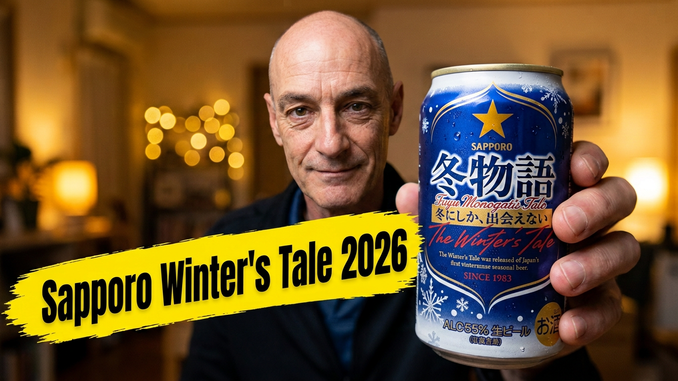
It’s that time of year again when one of Japan’s seasonal beers makes its annual appearance on the shelves of convenience stores and supermarkets. I’m talking about Sapporo’s Winter’s Tale (冬物語 – Fuyu Monogatari), a beer I’ve known since my very first year in Japan back in 1990.
I was always rather taken with this beer, not least because of its distinctive can designs and the literary quotations that Sapporo used to incorporate into its packaging. The name itself is borrowed from one of Shakespeare’s late plays, The Winter’s Tale, and there’s a rather interesting story behind it, as I explain in this beer tasting video:

A familiar sight in Japanese convenience stores
I picked up this year’s Winter’s Tale in mid-November. It’s always nice to see seasonal beers returning to the shelves, particularly those that have been around for as long as this one.
However, I was a little disappointed when I examined the can. The design is almost identical to last year’s. There are some cosmetic differences, particularly in the picture on the back, but it looks more like a few minor adjustments than a serious attempt at creating something new.
That is a shame because one of the pleasures of buying Winter’s Tale over the years was discovering what Sapporo had come up with for the latest edition.
When I first encountered the beer in 1990, the can design was quite different from today’s version. It featured a quotation from Shakespeare, and over the following years Sapporo produced a succession of different designs. There were white cans, light blue cans and, eventually, the familiar snowy winter imagery.
The blue can with the snowy scene that I remember came later. It wasn’t the original 1990 design.
Sapporo’s website has an interesting historical record of the packaging, going right back to the beer’s introduction in 1988. Looking through the different designs brought back quite a few memories.
How does the beer taste?
Winter’s Tale is brewed by Sapporo, whose headquarters are in Hokkaido, Japan’s northernmost main island.
At 5.5% alcohol, it’s slightly stronger than the typical Japanese lager, and it has a rather deeper golden colour than something like Asahi Super Dry.
The flavour is also a little stronger, with a bit more of an initial kick to it. My usual preference is Kirin Ichiban Shibori, so Winter’s Tale isn’t necessarily my favourite Japanese beer, but I enjoy having it a few times during the winter.
There’s another interesting detail on the ingredients list. Look closely and you’ll find the Japanese character 米 (kome), meaning rice. Yes, rice is one of the ingredients.
This means it wouldn’t meet the requirements of Germany’s traditional Reinheitsgebot, or beer purity law, which restricted the ingredients used in brewing beer. Japanese brewing traditions, of course, have their own approach.
Shakespeare on a beer can
The literary connection is what makes Winter’s Tale particularly interesting to me.
Shakespeare’s The Winter’s Tale is one of his later plays, generally classified as a tragicomedy. It contains some rather dark and tragic material, but eventually moves towards reconciliation and forgiveness.
The title comes from a line spoken by the young Mamillius, the son of King Leontes and Queen Hermione.
In Act Two, Hermione asks her son to tell the ladies a story. He asks whether they would prefer a merry or sad tale, and when his mother leaves the choice to him, he replies:
“A sad tale’s best for winter.”
He then promises a story involving sprites and goblins.
It’s a line that Sapporo obviously thought appropriate for a seasonal winter beer. The context in Shakespeare’s play, however, is considerably less cheerful than enjoying a beer on a cold evening. King Leontes has become consumed by jealousy and falsely suspects his pregnant wife Hermione of adultery. Despite her innocence, he has her condemned. Their young son Mamillius dies from grief, and the play takes a tragic turn before eventually arriving at its reconciliation through the following generation through the birth and survival of Hermione’s daughter.
The quotation is therefore rather more poignant than it might initially appear on a beer can.
A little Shakespearean history on the packaging
One of the things I particularly remember about the older Winter’s Tale cans is the use of Shakespeare quotations.
The 1990 design included a song sung by Autolycus in The Winter’s Tale:
“Jog on, jog on, the footpath way,
And merrily hent the stile-a;
A merry heart goes all the day,
Your sad tires in a mile-a.”
It’s a cheerful little song, and a rather nice choice for a beer.
Another particularly clever design appeared in 1996. This time, Sapporo turned to Shakespeare’s Richard III, adapting the famous opening line:
“Now is the winter of our discontent”
The can carried the rather amusing variation:
“Now is the winter of our content, made glorious by this fine ferment.”
I think that’s rather good!
Looking through the different cans over the years, it’s clear that Sapporo once put considerable effort into creating something distinctive for each winter season. Some of those old cans have even become collectors’ items.
I came across empty cans being offered for sale on eBay, along with old bottle caps. One bottle cap was listed for nearly 3,000 yen, or around $19!
It’s extraordinary to think that something you would once have thrown away after enjoying a bottle of beer could become a collector’s item thirty years later. Had I known, perhaps I would have kept a few.
Back to Shakespeare’s First Folio
I also took the opportunity to look up the passage in Shakespeare’s original text.
The famous line appears in Act Two, Scene One, when Mamillius is entertaining the ladies. Hermione asks him to tell a story, and their exchange about whether it should be merry or sad leads to the familiar:
“A sad tale’s best for winter.”
I find it interesting to return to the original text and see how a phrase that has become familiar through popular culture actually functions within the play.
In this case, the line is a small moment of domestic amusement before the tragedy that follows. Mamillius is a young boy telling stories to amuse his mother, unaware of the terrible events that are about to unfold.
It’s a reminder that Shakespeare’s plays often contain moments of humour and everyday conversation alongside their more dramatic themes.
Another Winter’s Tale
So, that’s another year of Sapporo Winter’s Tale.
The beer itself is perfectly enjoyable, even if it isn’t my first choice among Japanese lagers. I still look forward to seeing it appear in the shops each winter.
I do wish Sapporo would return to its old tradition of producing a completely new can design every year. There are plenty more Shakespeare quotations they could use, after all!
For now, though, I’ll raise my glass to another winter season in Japan.
And, as Mamillius reminds us, a sad tale’s best for winter.
Cheers!
David Hurley
#InspiredFocus
Leave a Reply