
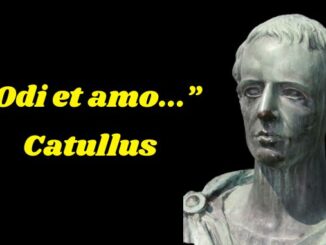
The Brilliance Of Catullus 85 Explained

February 17, 2012 David Hurley 2

The most famous poem of Catullus is one of his shortest, Odi et amo, quare id faciam, fortasse requiris. nescio, sed fieri sentio et excrucior. Here is Ezra Pound‘s translation: I hate and love. Why? You may ask but It beats me. I feel it done to me, and ache. [Read more…]

No Image

By Nature’s Statute With Plesaunce Pricked

February 14, 2012 David Hurley 0

What marvel, when Bacchus and Apollo smile on me, that a host of maidens should give me choco on Saint Valentine’s Day? For this is the day, as our Chaucer relates, this is the day when birds choose their mates and are pricked with “plesaunce” by Nature’s statute and all [Read more…]

No Image

Propertius Unbound: Pounding The Butler

February 13, 2012 David Hurley 0

What happens when Butler’s 1912 Loeb translation of the second elegy of the third book of Propertius, the one that Pound managed to mangle with a Marcian vintage, is declaimed in an approximation of the Poundian delivery? Meanwhile let us return to our wonted round of song; let the heart [Read more…]

No Image

Extremely Cool X Chess Championships

February 3, 2012 David Hurley 0

While searching for information on replies to the Zukertort opening the other night I came across the X Chess Championships television series that pits young chess players against each other in a “chess reality tv show”. I was instantly hooked! These are fast games between young players; each player has [Read more…]

No Image

His Life & Death Were Made Seamless & Single

February 3, 2012 David Hurley 8

This weekend marks the tenth anniversary of the death of my mad, bad, good friend Allan Jenkins in Hiroshima in the early hours of Monday 4th February, 2002.

Ten years.

There is always a double perspective to past times; because the mind’s eye can recall so many incidents, it seems but yesterday when this or that occurred and yet when all that has happened since that day is called to mind, and all that has changed, it seems as if those previous events belong to a distant epoch and another country.